“Road accidents kill more people than any war,” Union Minister for Road Transport and Highways Nitin Gadkari told Parliament, noting that 485 lives were lost every day on Indian roads, leaving 1,268 people injured or disabled, in 2024. Unlike leaders who stop at rhetoric, Gadkari has operationalized a “5Es” framework, Engineering, Enforcement, Education, Emergency Care, and Empathy ~ to tackle this serious challenge to the country’s social, economic, and legal systems.
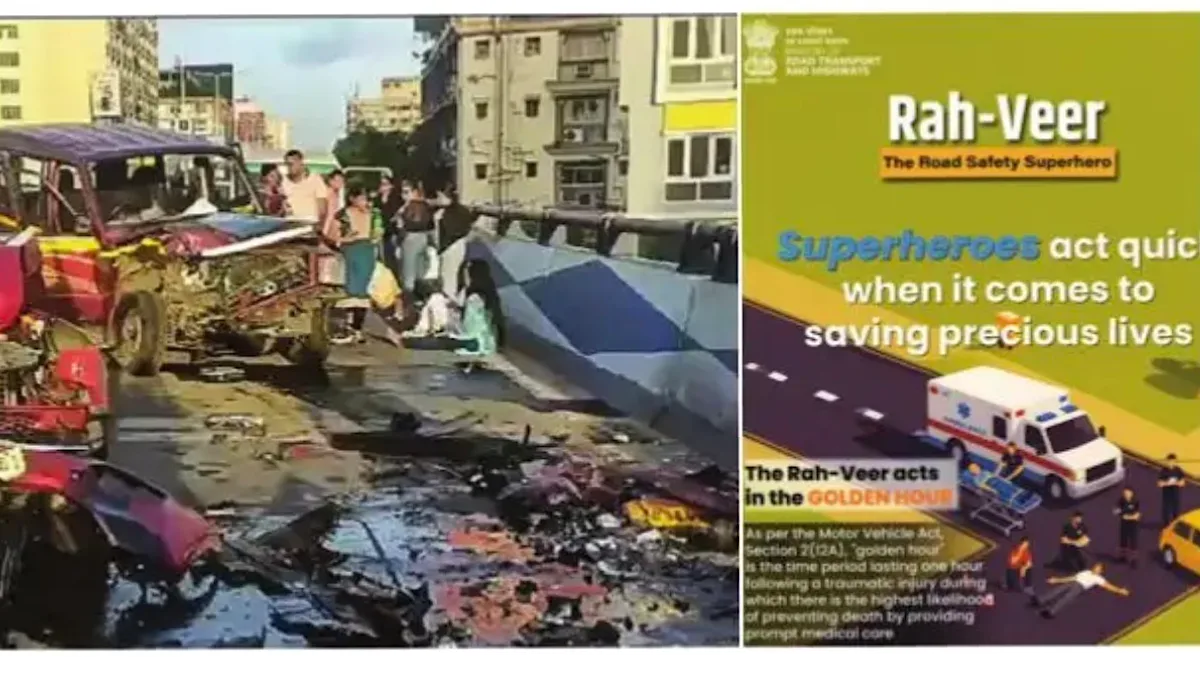
On the legal front, the Motor Vehicles (Amendment) Act, 2019, introduced stiff penalties to counter the culture of non-compliance. Cashless Treatment of Road Accident Victims Scheme, 2025 ensures victims receive immediate medical care up to Rs 1.5 lakh. National Road Safety Month (January) saw the ambitious announcement of Vehicle-to-Vehicle (V2V) communication system that allows vehicles to “talk” to each other within a 300-meter range, alerting drivers to sudden braking or blind-spots. Although India has only 1 per cent of the world’s vehicle population, it accounts for nearly 11 per cent of global road accident deaths ~ about 1.77 lakh fatalities annually, costing the nation nearly 3 per cent of its GDP.The Law Commission states if proper medical treatment is provided during the “Golden Hour” (the first 60 minutes), up to 50 per cent of these deaths can be prevented. However, ambulance response times in India range from 8 to 35 minutes.
Advertisement
A study from Iran by Mohammad Jafar Sepahvand et al shows that in 85-97 per cent of accidents, ordinary citizens are the first to reach the spot. However, only 11 per cent provide first aid, while 68 per cent merely stand and watch. Some time ago in a remote town in Andhra Pradesh, a mother knelt on a blood-stained road, pleading with passers-by to save her dying son. No one helped. The young man died before her eyes. Incidents like these create despair that society has become increasingly irresponsible.Fortunately, this is not entirely true. The reasons why people at accident sites fail to respond can be grouped into three categories:
1. Psychological factors;
2. Legal misconceptions;
3. Lack of first-aid knowledge. Understanding and addressing each is critical to transforming bystanders into life-savers. The most complex psychological barrier is the “bystander effect.” When many people are present, each person tends to think, “Someone else is more capable will help.” As a result, no one steps forward. Consider another tragic road accident a few days ago in Andhra Pradesh, where a private travel bus collided with a truck after a tyre burst, setting both vehicles ablaze. Shaik Mehraj, a passing local driver, assisted by his nephew, did not hesitate despite the absence of many bystanders. By breaking the bus windows, he saved 36 passengers. He was awarded a Certificate of Appreciation on Republic Day.
Similarly, in the road accident involving cricketer Rishabh Pant in Uttarakhand, although it was night and only two passers-by ~ Rajat Kumar and Nishu Kumar ~ were present, they broke the car windows before it caught fire, rescued him, and rushed him to the hospital. These examples show that when fewer people are present, the likelihood of help actually increases.Almost magically, once young people are made aware of these invisible barriers, they overcome them and step forward to help; all it takes is awareness. The Good Samaritans Rules, 2020 protect individuals from civil or criminal liability when they voluntarily come forwardto provide immediate assistance or emergency care to an individual injured in an accident, crash, or any other emergency medical situation. They may leave after admitting the victim to a hospital and are not required to disclose their name, phone number, address, or any personal details, unless theywish to act as a witness.
“Rah-Veer” scheme even offers cash rewards of Rs. 25,000 and certificates of appreciation. Hospitals are required to display these provisions at their entrance. The law is stronger in some countries. Under the French Penal Code, failing to help a person in danger is a criminal offense, carrying a potential five-year prison sentence. Similarly, under German law (Section 323c), stopping to help is mandatory, if safe. Bystander intervention is significantly higher in these nations. Some people even freeze due to the intense pressure of making high-stakes decisions. With proper first aid training and awareness, young people can develop the confidence to take initiative. Until an ambulance arrives, bystanders can take the following nine critical first-aid actions:
1. Ensure your own safety first. Watch out other vehicles, electric wires, and fire hazards.
2. Call 112 or 108 (Ambulance). Do not assume someone else has already called. It is better if multiple people call than if no one does.If there are two people, one should call while the other helps.
3. Talk to the victims, reassure them, and try to keep them conscious.
4. Stop bleeding: If blood is flowing from a wound, press firmly with a clean cloth until bleeding stops. Tie a bandage firmly (but not too tight).If fingers turn blue, loosen the bandage slightly.
5. Clear airway obstruction: If breathing is obstructed (snoring or gurgling), gently tilt the head back by placing one hand on the forehead and lifting the chin with the other.Remove visible mud or blood from the mouth using a finger.
6. Recovery Position: If the victim is breathing but unconscious, gently turn them onto their side. Place the upper hand under the head for support, bend the upper leg at the knee, and tilt the head slightly backward to allow fluids to drain.
7. Suspected spinal injury: If there is neck pain or inability to move limbs, do not move the victim. Keep the head and neck aligned. Incorrect movement can cause paralysis.
8. CPR (if the heart stops): If the victim is unresponsive and not breathing (or breathing abnormally), place both hands at the centre of the chest and press hard and fast at 100-20 compressions per minute.
9. Stay until the ambulance arrives. In Germany, Austria, and Switzerland First Aid training for driving licence applicants is mandatory. Germany mandates a 9-unit “Erste Hilfe” course. Australia and New Zealand implement Graduated Driver Licensing, with a three-tier hierarchy, earner, Provisional, and Permanent Licence system. Provisional licensed drivers cannot drive without peers or during night. This reportedly reduced crash rates among the youth. The “112 India” app (Emergency Response Support System) includes tools called “Volunteer” and “Shout.” Any citizen can register as a volunteer. When a person in need touches the “Shout” button, an SOS message with location is sent to the control room and nearby volunteers. This system enables quick help until ambulances arrive. The next goal should be using Artificial Intelligence (AI) to prevent accidents. A recent bus accident near Kurnool that claimed 20 lives occurred when a bus hit a motorcycle lying on the highway after its intoxicated rider had fallen earlier. CCTV footage later showed the biker riding dangerously shortly before the accident.
Despite widespread CCTV coverage, cameras are largely used only to reconstruct events after lives are lost. Though real-time monitoring of thousands of feeds is beyond human capacity, AI systems can analyse live CCTV feeds to detect drunk or erratic driving, wrong-side movement, and dangerous speed patterns, and trigger instant alerts to police. Australia has deployed AI-driven real-time CCTV analytics to alert police during ongoing risks, and China’s “City Brain” project uses large-scale AI surveillance to identify hazardous driving behaviour. Under Article 51A of the Indian Constitution, abjuring violence and showing compassion towards fellow citizens are Fundamental Duties. Saving accident victims is a vital part of this duty.
(The writer is founder-member, 51ABI Foundation, a transparency and equality advocate and author. The opinions are personal)